What the investigation does
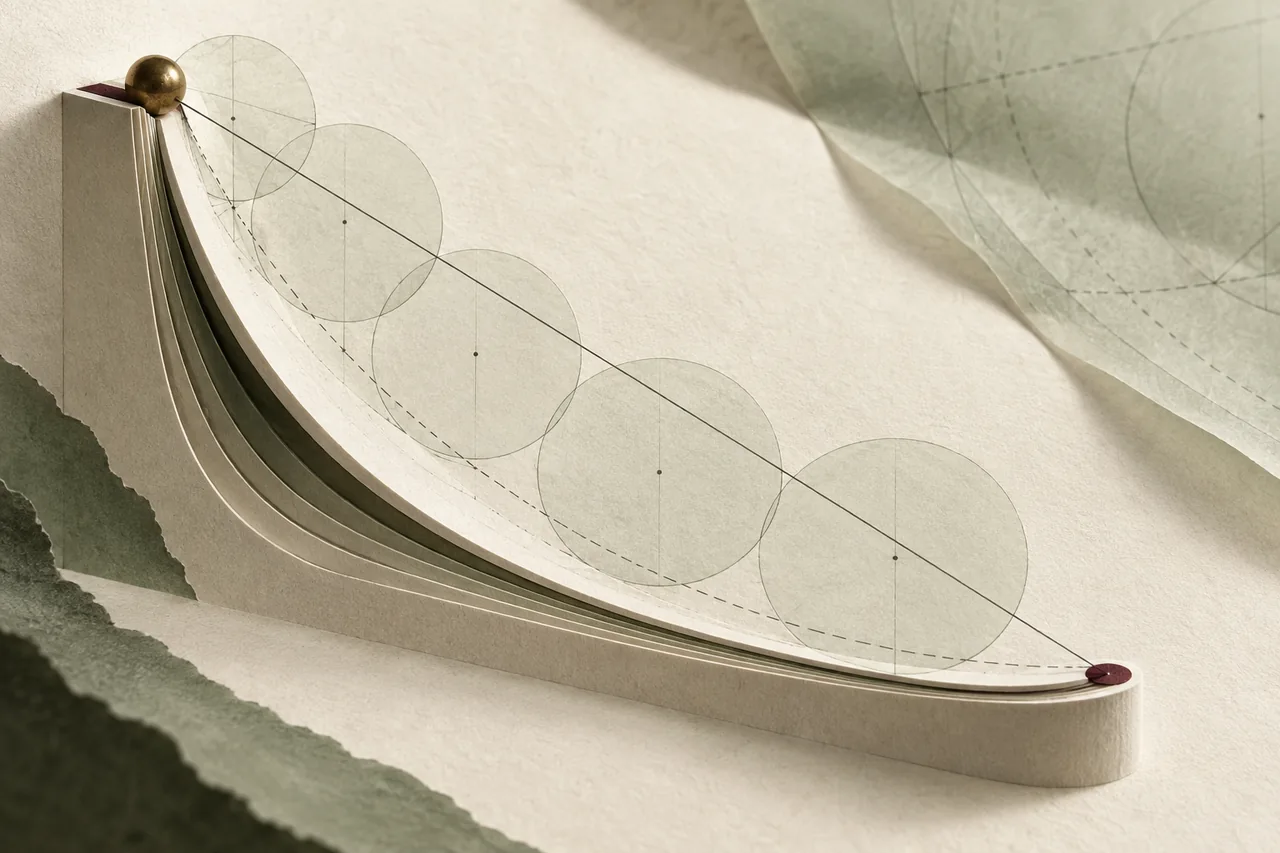
The essay asks which frictionless path between two points at different heights gives a particle the shortest descent time under gravity. It begins with simple straight-line cases, then constructs segment approximations and a TI-83 calculator program before deriving a continuous time integral from arc length and conservation of energy.
Candidate curve families are compared numerically, followed by an investigation of the inverted cycloid and Bernoulli's argument using the analogy with refraction. The conclusion distinguishes the fastest tested curve from a general solution, and suggests extensions involving resistance, initial velocity and other cycloid properties.
Why this example is worth reading
The progression from manual segment calculations to a calculator program and then calculus makes the mathematical development visible rather than presenting only a final formula.
The comparison of curve families identifies a limitation of numerical search: testing many examples cannot establish that no faster curve exists.
The final argument connects the computational investigation with an established proof and makes the simplifying physical assumptions relevant to the conclusion.
What the examiner highlights
The examiner values the original calculator-based discrete approach and the student's recognition of its limitations.
The commentary praises clear presentation and thorough explanations, while judging the extended middle comparison of curves unnecessarily long.
What to examine critically
The examiner considers the middle sequence of curve tests longer than its mathematical contribution warrants. A new investigation should retain only comparisons that advance the argument.
The conclusion applies to the idealized gravitational model. Friction, air resistance and nonzero initial speed require separate treatment; numerical agreement alone is not proof.
Apply it to your own work
Explain why each new method is needed by identifying a limitation of the previous one.
Keep a clear distinction between a numerical conjecture and a mathematical proof.
Use a familiar classical problem to demonstrate independent reasoning, with precise attribution of established results.
Essay & assessment material
Read the original material alongside the breakdown, or download it to keep.
A separate one-page examiner commentary accompanies the essay. It praises the investigation and identifies an overlong middle section; it does not state an individual numeric mark or letter grade.
Source & assessment context
50 More Excellent Extended Essays (IB, 2011). The source PDFs retain their original attribution. The analysis on this page is AsterDraft’s independent teaching commentary.
Selected excellent essay; numeric mark not stated. A separate one-page examiner commentary accompanies the essay. It praises the investigation and identifies an overlong middle section; it does not state an individual numeric mark or letter grade.